
Winter 2025
December
Will here. Happy almost-New Year! I was catching up with an old friend recently who asked, “What’s the deal with you and food hubs?” I laughed and spared him my soapbox speech. You all aren’t so lucky.
The first local food hub I met was, fittingly, Local Food Hub in Charlottesville, VA. I was a line cook then. On our first delivery from the hub, I rejected a flat of raspberries that were on the edge of molding and probably said something cringey like, “What, local farmers can’t grow good raspberries?”
Today, I’ve been helping to lead the Eastern Food Hub Collaborative for just over three years, and I’m still sometimes talking about raspberry Q/C. I like the work of food aggregation and distribution. I like warehouses, and clean cardboard smell, and the way a well-built pallet holds its shape when you move it. I like the white noise of a walk-in. I like the way food flows through a hub: folks receiving farm deliveries, rotating inventory, staging orders, loading out, trucks leaving the dock. When we talk about concepts like “systems change” and “transformation” and “resilience,” it can be hard to see in your mind’s eye. With food hubs, the work is right there in front of you, being done by real people, for the benefit of the place where you’re standing. I like that. Food hubs are refuges for doers. I also love the purpose. However different their models, most food hub folks agree on two things: food is a universal human right, and farming is an essential business.
Those beliefs can seem to conflict, or create a “buy high, sell low” model doomed to fail. And yet, food hubs across America endeavor to demonstrate a food system that can support the livelihoods of those who farm while also feeding all those who are hungry. They innovate, adapt, and learn from each other. Forerunners fall by the wayside, and are picked back up by would-be competitors. They are mostly invisible, hidden in the middle of the chain that connects farms to plates. They are overworked, under resourced, dismissed as middlemen, and chastised for being too big, too small, too radical, too complicit.
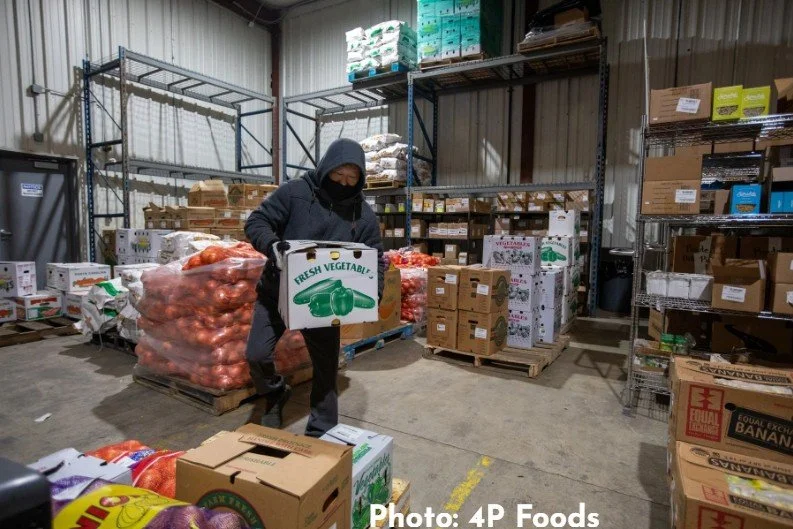
Still, they keep doing the work — late night warehouse staging, early morning farm visits, cross docks in gas station parking lots.
It’s an audacious movement-turned-business-sector that tries, day after day, to make life better for everyday people through fresh food. It’s systems change happening in real time, measured through farmers staying on their land, through healthy lunches and kid’s full bellies. It’s infinitely complicated, constantly changing, and endlessly fascinating. It exhausts me, and fills me with intense inspiration and gratitude.
That's my deal with food hubs. They’ll never efficiently produce profits like the extractive, consolidated system we live in today. They do something far more extraordinary: they remind us that what’s broken can be repaired, and that all of us can play a part in a solution still unfolding. As we wrap up 2025 and look ahead to the future, we’re sending Season’s Greetings and stockings full of good vibes to all of y’all in the work of building a better food system.
Happy Holidays!
Will (and the Seed Change Team)
P.S. - Not yet signed-up for our newsletter? Do so here.
We solemnly swear that we’ll never share your email or spam your inbox.
What We’re Cooking Up: Holiday Edition
As much as we are a group of friends who love nothing more than waxing poetic about the beauty of a perfectly ripe summer peach, there is something to be said about a season that encourages us to prepare day-long braises, to bake and eat sweets in a manner that at would any other time seem indecent, and to find comfort and celebration in recreating the family classics we’ve been enjoying since time immemorial. So for the month of December, may we present: our holiday classics. (No shame in going back for second helpings!)
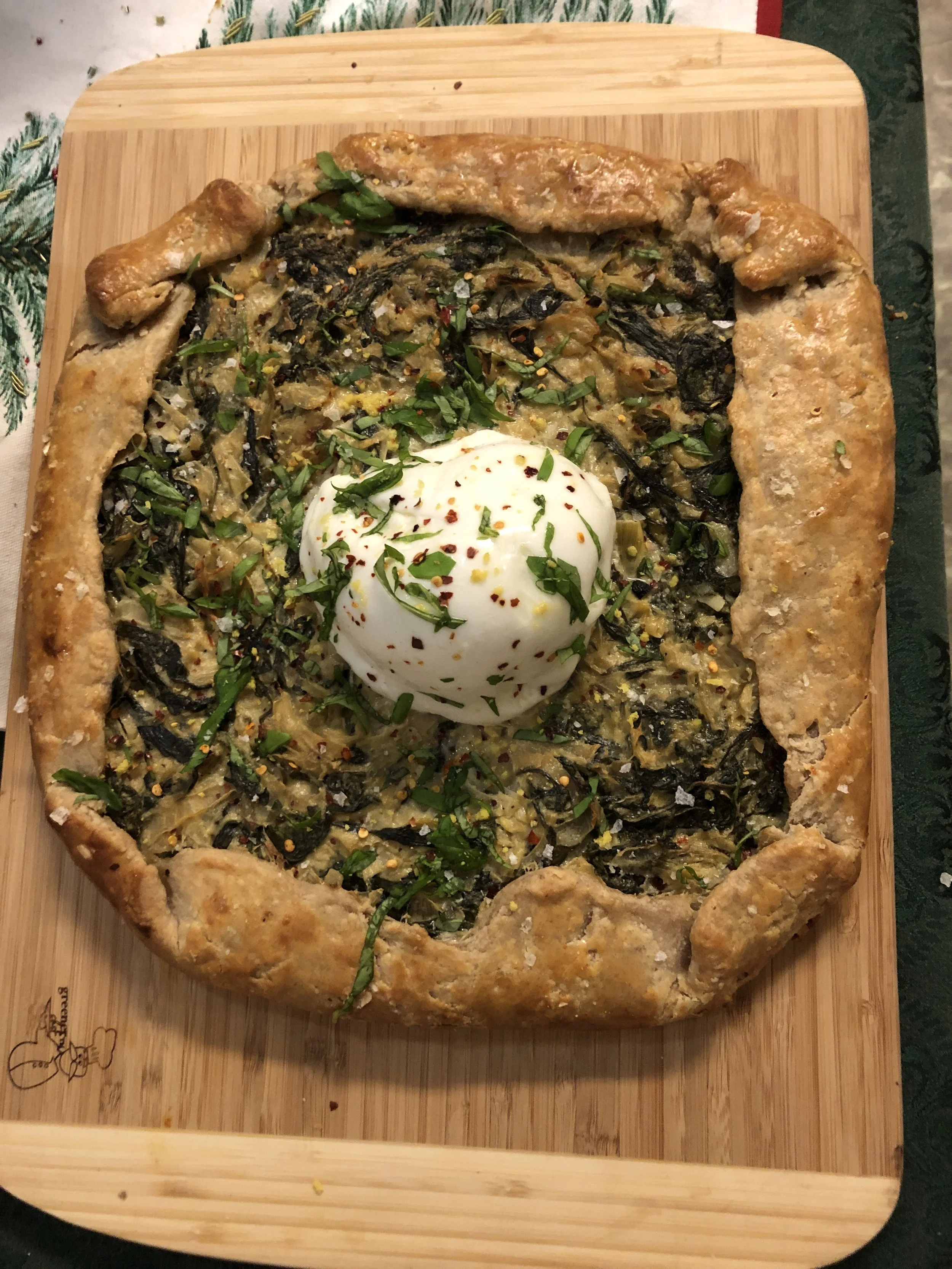
Elizabeth: At this time of year we are reminded “be careful what you get good at,” because if you get good enough at it, the chances are you will be requested to make that dish every year, for the rest of your god given life. For me that dish is a savory galette. I’ve learned the hard way that any attempt to branch out will be met by vociferous remonstrations by all three of my older sisters. Fortunately, a galette is an easy, forgiving, and adaptive dish. So long as you make a good pastry dough (the key is keeping the butter cold at all costs), you can fill it with whatever your heart desires. My family’s two favorites are bacon, leek, and mushroom as well as butternut squash and caramelized onions.
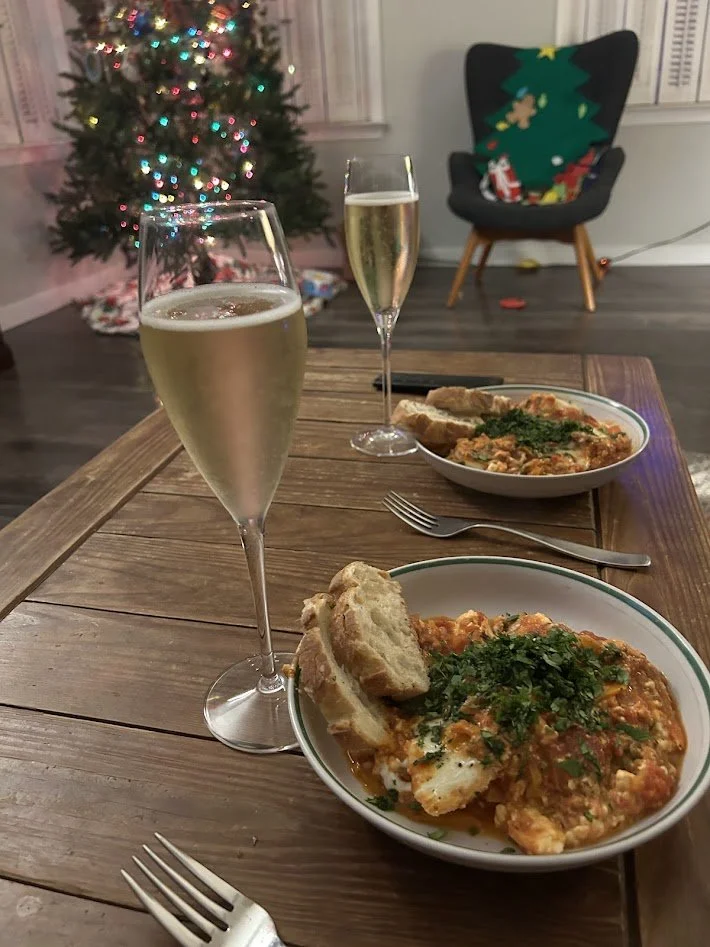
Will: Jen and I have a Christmas morning tradition that we’ve been doing for the last twelve years (!): champagne and shakshuka*. Shakshuka is a tomato-and-egg situation originating in North Africa and popular throughout the Middle East. That means I have absolutely no cultural connection to it whatsoever, but my goodness - it’s a next-level one pan meal that’s entirely appropriate any time of the day, and you likely have all the ingredients in your house already. On Christmas morning, once the presents are open, I throw a bottle of sparking in the freezer and cook a batch. It’s on the table in 40 minutes or less (though let’s be real, we spoon into a bowl and eat it on the couch in our pjs) with enough oomph to fill your belly, but not so much that you’re still stuffed when dinner comes around.
Why pair with sparkling wine? No reason at all, other than that it’s been a big year and you deserve it. 🍾🥂🍾
* My personal method is more like this one Melissa Clark did for NYT, but there’s a paywall. Either way, poach eggs in seasoned tomato sauce with cheese and it’s gonna rule.
Ellie: I am VERY lucky to have married into a Vermont family, which means I get to spend lots of winter holiday time in a snowy, mountainy place. In addition to Bernie Sanders’ knitted mittens, skiers with inferiority complexes, and Ben and Jerry’s, Vermont also is synonymous with maple syrup. That means that one of my favorite things to make this time of year is the salted maple pie from Sister Pie in Detroit. It’s decadent, it’s got great texture, and it feels classic and a little new at the same time. It’s also pretty easy to make but see Elizabeth’s note above about butter temperature!! This pie goes really great with a bourbon on the rocks after your aunts and uncles have left.…
Partner Feature: Copper River Fish Market
Elizabeth: If you’re reading this then chances are you agree: 2025 has been a rough year. When things have gotten particularly tough, I think about our partner Sarah Ecolano, founder of Copper River Fish Market, steering a ship through freezing ocean waters at an hour when most of us are sound asleep in the comfort of our warm beds. Getting through the Alaskan salmon fishing season? Now that’s tough. Not only are we big fans of Sarah and the work she does to support small, sustainable fishers in Alaska, we are obsessed with being able to get shelf-stable, sustainable sourced wild Alaskan salmon shipped right to our door. (True story: smoked salmon is pretty much my all time favorite food.) I love Sarah’s story and her insights into a food that I care a lot about, and I can’t get enough of her smoked salmon. And I bet after reading this, you will feel the same.
-
I'm Sarah. I'm a generational small-boat fisher(wo)man living in Cordova, a tiny fishing town in South Central Alaska, surrounded by mountain ranges, glaciers, forests, and river systems. We sit next to the Copper River Watershed, which supports our region's Copper River Salmon. I've been on a fishing boat longer than I can remember, with my first trip at a few months old. Every summer of my life has been syncing-up with wild fish runs, where out of necessity everything else must fall back and make room for whatever it may be the fish demand. Each year is different, as is each day.
-
Copper River Fish Market started out of necessity and being fed up with the status quo. After a particularly grueling patch of weather and work conditions, we radioed in to the corporate buyer about our small catch, and learned what they would pay for it. The captain accepted it; I didn’t.
After some discussion with the Captain. I convinced him to sell the fish to me instead. I was able to find higher paying markets, more direct markets for the catch and proved my hunch that the middle man was not a necessity in getting our catch to market. From all those years ago I have helped dozens of fishers earn more for their catch while also providing customers a more premium product at a fair price.
-
Let me start with a quick biology lesson: Salmon begin and end their lives in fresh water, and spend their lives at sea. The female fish lay eggs in riverways; the males fertilize them and it takes a winter for the eggs to mature and then several months for the little baby fish to migrate from inland waterways out to the ocean.
Different species of salmon have different lengths of time they spend at sea before returning to spawn. The salmon complete their lifecycle and die after spawning, as their bodies are no longer compatible with fresh water. They waste away and in the spring the new hatch nibbles up what remains of them. Nutrients from the dead salmon play a vital role in flora and fauna of forest health. Since we insert ourselves in the food-web just prior to their spawning cycle and subsequent death, there's a bit of solace knowing the creature being eaten was just about to die.
-
If your salmon isn't labeled wild, it's factory farmed. There is no commercially available wild Atlantic salmon, and most Atlantic salmon eaten on the East Coast is imported. Pacific salmon is not farmed. Wild and farmed salmon are completely different foods.
Farmed salmon doesn't offer the same nutritional benefits and even carries consumption limits for some individuals due to antibiotics used in dense fish pens. These operations also cause major ecological harm, with runoff impacting surrounding ocean waters. Many countries restrict or heavily tax these farms because of environmental damage.
The feed for factory farmed salmon is another issue: coastal communities around the world lose local food sources as wild fish are turned into fish meal—requiring roughly 5 pounds of wild fish to produce one pound of farmed salmon.
Supporting wild salmon also supports small businesses. Alaska's fisheries are made up of owner-operators; salmon permits must be privately held by individuals, not corporations. Fishers don't own the fish until they catch them, serving as the link between wild food and eaters who care about where their seafood comes from. Protecting sustainable fisheries preserves public access to wild foods.
-
The season is short but intense. With nearly 24-hour daylight, we joke that we only work "days." Weather and tides dictate everything. We’re constantly checking forecasts and prepping for the next anticipated fishing opportunity. Once the opener starts, it's nonstop—set the net, pick the net, ice the fish, repeat. You eat when you can, sleep whenever possible, and monitor weather constantly.
All of Alaska’s fisheries have firmly enforced catch limits that are based on close monitoring by scientific modeling to ensure we do not exceed sustainable catch limits. This means that we cannot remove fish in a quantity from the food web that would jeopardize the longevity and health of a fish species, nor can our fishing impart a negative impact that would threaten another species of fish or mammal. This is enforced at a very granular level. For instance our Copper River fishery actually has sonar stations in place that in real time count the number of salmon that have returned up river to spawn.
Before our fishery opens each spring fish must first return to the river system, only then will our fishery open for a short catch cycle. There is a pause to allow more salmon to enter the river system and make their way past the sonar counter. After a satisfactory number passes by we can then fish again. This on again off again cycle repeats from spring until fall with hourly updates posted by the scientists so that fishers can hedge our bets on when we might fish again, but we are reliant on official notice being given that our fishery will commence at a certain date and time, only then do we know the duration of what’s ahead of us. There can be an awful lot of anticipation. It’s demanding and a cycle that is out of our control and on short notice supersedes other plans that may have been made in the interim.
It requires patience and flexibility, but it's the life most of us grew up with.
-
It's been a tough several years. Consolidation in the seafood supply chain has replaced local buyers with large conglomerates, leaving some towns dependent on a single corporate buyer. Fishers deliver their catch without knowing the price and often learn later that they're being paid less than it cost to catch the fish. When buyers competed, we could trust we'd at least cover expenses. Now fishers often gamble on whether their catch will pay or cost them.
That's why the work I do matters. Helping fishers capture more of the supply chain shifts power back to small-boat harvesters. It's motivating to see progress, even in small increments. And yes—I'm stubborn. If there's an injustice, I won't sit still. Real change starts with individual actions that build into a movement.
-
I love the distinct flavor profiles of Alaska's wild salmon. Each variety is genetically different—much like breeds of pigs (think Red Wattles or Berkshire), cows (Angus or Wagyu), or apples (Honeycrisp or Red Delicious). Copper River Salmon is known for elevated flavor: our King is incredibly rich, Sockeye has deep complexity, and our lesser-known Coho has a clean, bright flavor that's a close second to King for me.
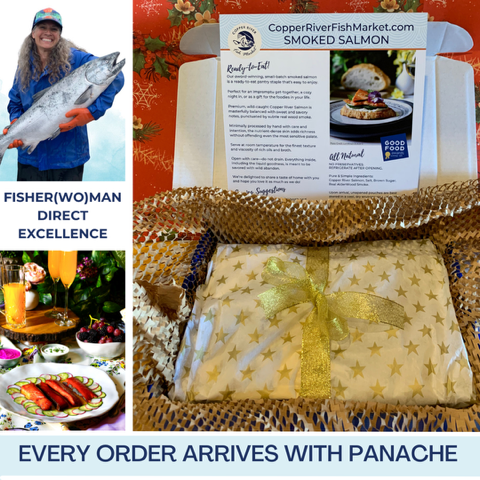
Our smoked salmon is shelf-stable until opened and made from the best fish we catch with only three ingredients. We ship to the lower 48, and I personally pack each order. If anyone wants to try our award-winning smoked salmon, visit www.CopperRiverFishMarket.com. It's great on salads, charcuterie boards, or a bagel with cream cheese—and makes a unique gift. If your readers want to learn more, they can sign up for my newsletter on our website.

What’s on the Horizon
Ellie: It’s an exciting season for the Eastern Food Hub Collaborative. We are very pleased to announce that we have a new fiscal sponsor, Locus, a community development finance institution based in Richmond, VA! Administration and financial management might not be what gets most people not named Will Gray out of bed in the morning, but it is a crucial part of making a network function and grow.
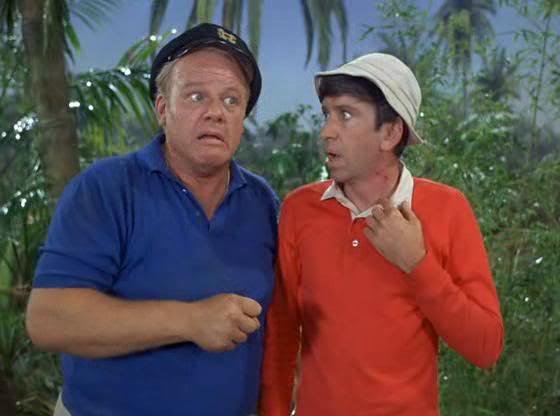
EFC found itself seeking a new administrative home after our previous parent organization, Local Food Hub, made the difficult decision to close up shop late last year. This left EFC in the exciting but daunting position of needing to figure out what we wanted to be when we grew up. The members, ever clear-eyed and solution-oriented, opted for a fiscal sponsorship. So, team Seed Change embarked on a “few month process” to find and engage a fiscal sponsor to provide back office support and management to the EFC to complement the backbone services Seed Change provides. Insert Gilligan’s Island “three hour tour” joke here.
Locus turned out to be the perfect partner for the EFC. Not only are they friends and neighbors to the Seed Change backbone team, they also have all the qualities of a great fiscal sponsor. They are deeply values aligned, supportive of our vision, highly organized (they’re a BANK!), flexible, communicative, and creative. Now that it’s official, the EFC can accept support from a wide range of funders and partners, (so if you’re reading this, funders, feel free to email me directly) which enables the network to capitalize on the momentum it's built over the last six years.
At the same time that we’ve made this transition, we’ve seen other networks and peers exploring and undergoing similar processes. It feels like there is something in the air around searching for, imagining, and creating the right home for food systems networks. Perhaps this relational approach fits particularly well in a fiscal sponsorship. My theory is because of its balance of structure and flex. Anyone accepting philanthropic or federal funding needs oversight, compliance, and systems that enable transparency and accuracy. But networks also need nimbleness. They need to be able to bend without breaking, to react to the asks of their members, and to be opportunistic when the right work arises. This kind of responsiveness can sometimes be hard in traditional nonprofit frameworks that require a little more predictability and forethought.
As a natural-born pattern identifier, I’m interested in what this trend might mean. Have you gone through a similar transition recently? Did an apple fall on your head and make you feel like you might want to? Let us know! We’d love to hear about your experience, share what we’ve learned, and maybe save you a month or four.
Through what turned out to be almost a year-long process, we learned a lot about various legal, financial, and paperwork-y details about fiscal sponsorship, and got advice from many smart, experienced friends. Lucky for us, one of those friends worked at Locus, an organization that does a lot of work to support the development of local and resilient food systems in the Mid-Atlantic and beyond.
The best holiday songs you’ve never heard

It’s that time of year, y’all! Chestnuts are roasting. Frosty is coming to life. We are all trying to square our concerns about hyperconsumerism with the desire for some new stuff. What better way to handle any and all of those situations than with some holiday tunes. No shade to Mariah Carey, but it’s nice to mix it up a little, so we’re sharing our favorite, weird and mostly unknown (outside of our families) holiday tunes. Put on while frantically cleaning the house, trying not to overthink the morality of magically animating snowmen, or considering the merits of adults giving each other homemade coupon books as gifts. Happy Holidays, everyone. Here’s to way more peace, love, and joy in 2026.
Thanks for reading this far. And if you’ve made it this far, you really are a friend. We’re sending everyone warmth and light during the coldest, darkest time of the year — and hopes that we may carry this light together in the year to come.
