Spring, 2026
One of the reasons I work in food systems is that I don’t want to be a vegetarian. You don’t have to have a career in this field to know the horrors of factory farming. I’ve been thinking a lot lately about the idea of “being a good ancestor.” When I consider the norms and behaviors of today that will make our future descendants shudder, factory farming and the staggering 224 pounds of meat that Americans eat per year is always towards the top of the list. But as a southerner, home chef, and - sorry not sorry! - gourmand I am going to give up spicy chorizo, lamb kofta, and slow-cooked brisket kicking and screaming.
One of the many wonderful aspects of living in Durham, North Carolina is that I don’t have to choose between vegetarianism and factory farmed meat. That’s because Durham is proud to be the home of Firsthand Foods, a woman-owned food hub that sells local, pasture-raised meats from NC farmers. Every single product they make is delicious (I can’t speak highly enough of the spicy fennel sausage) and it’s a choice I can feel good about.
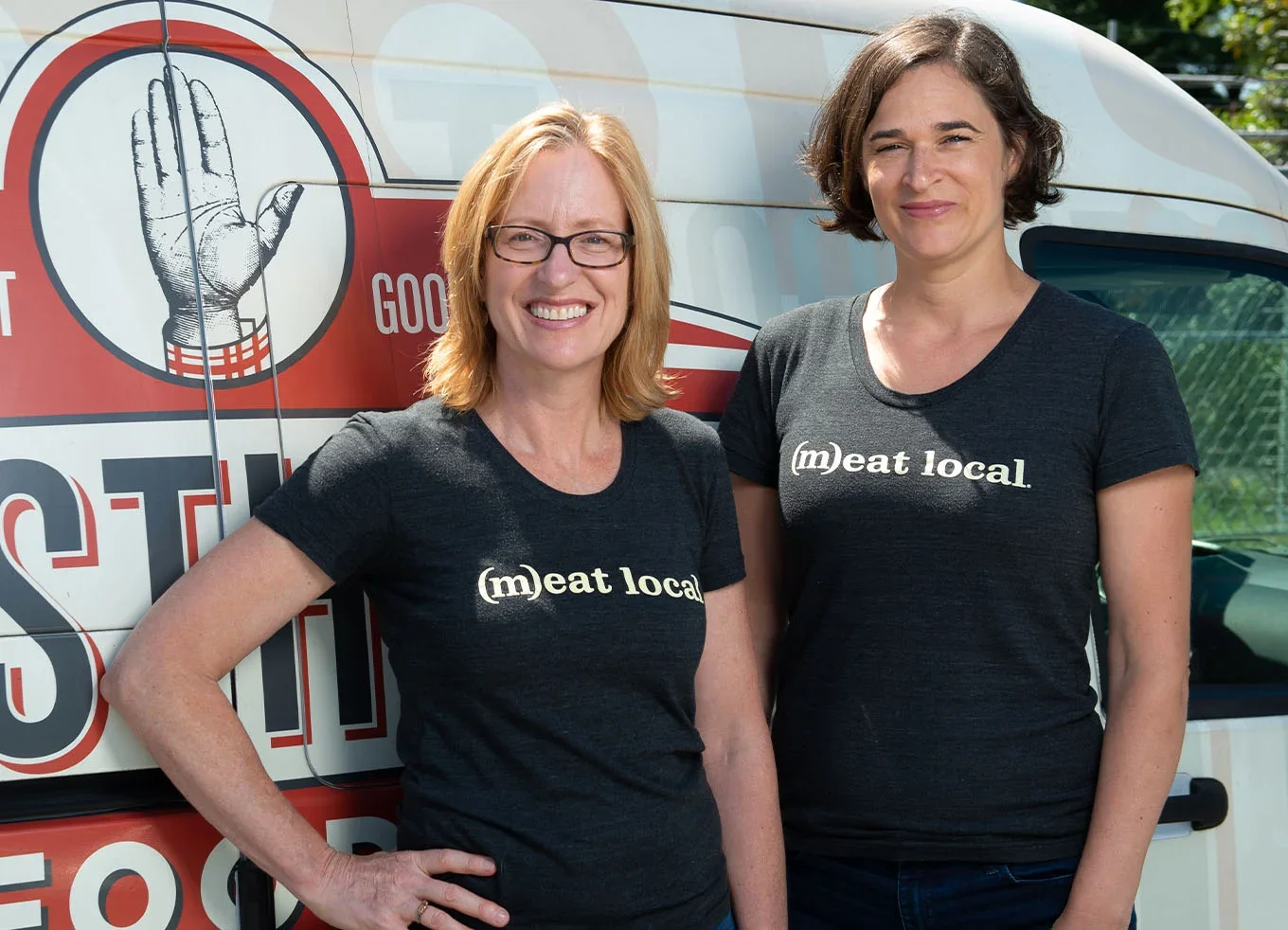
Meat Jennifer and Tina, Firsthand Foods Co-Founders
When I first met Firsthand co-founders, Jennifer and Tina, I was a little star-struck. (Did I spill coffee down my shirt? WHO’S TO SAY?) Not only because they were responsible for nearly all of the meat consumed in my household - but also because they are two badass founders that created such an important business for NC farmers - and in a male dominated field. Firsthand was one of the founding members of the Eastern Food Hub Collaborative, and as I’ve gotten to know them better through facilitating the EFC, I’ve also grown to admire the shared leadership and friendship that Tina and Jennifer bring to the table.
We caught up over lunch recently at Hops and Flower, one of the many Durham restaurants featuring Firsthand meats. Much of what we talked about was this: how do you maintain high-functioning, thriving, trusting friendship and partnership with your co-founders? I got married last September and I joked with my wife that I was already “business married” to Ellie and Will. When we started Seed Change we made a commitment that we would always center and protect the importance of our friendship (for richer or poorer, in sickness and in health).
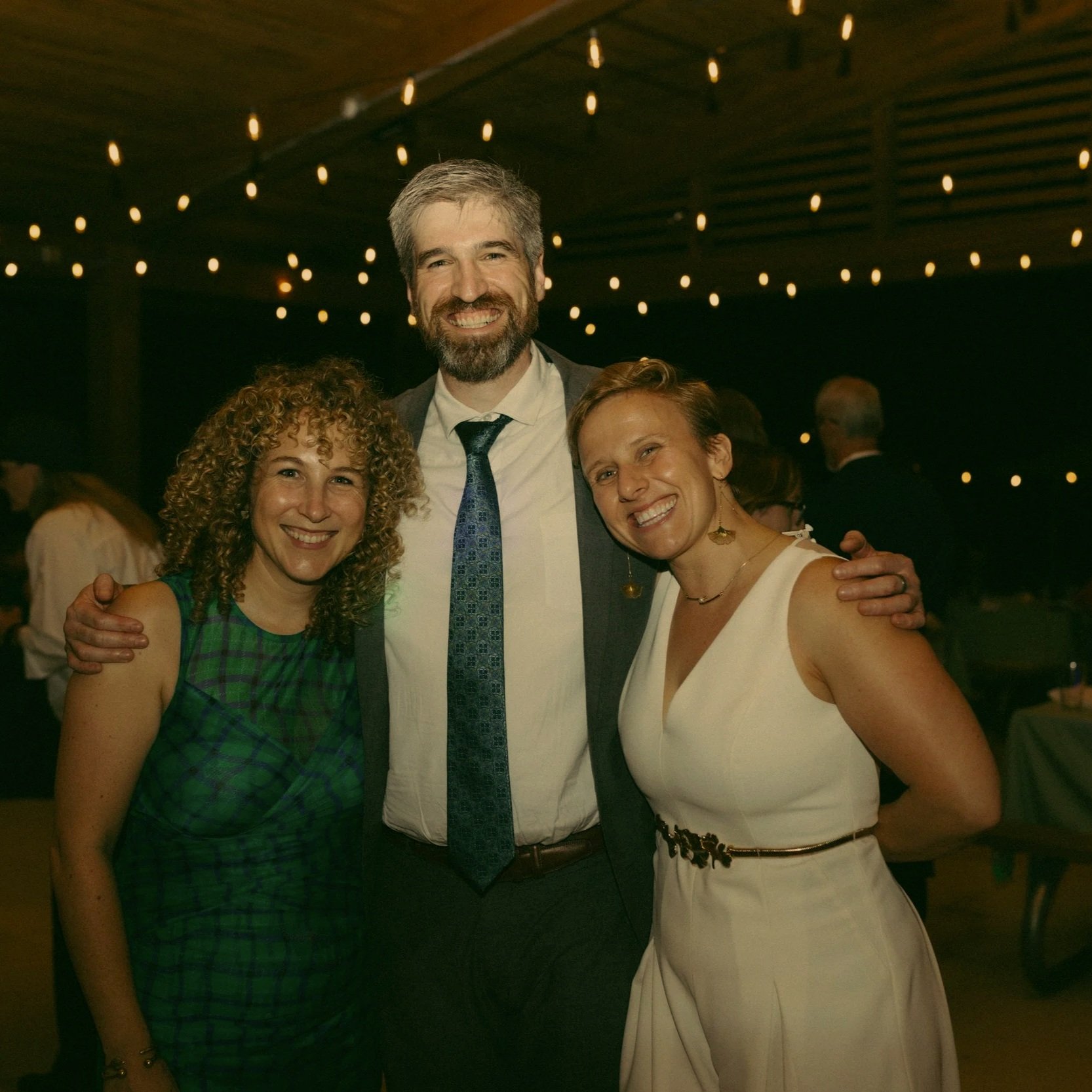
Ellie, Will, and me at my actual wedding.
Jennifer and Tina have been in this for over a decade - and much of their advice on keeping a healthy partnership alive was aligned with practices that are foundational to how we run Seed Change: the importance of regular in-person retreats, getting real good at providing and receiving feedback, knowing and playing to one another’s strengths, and continuously evaluating and improving the systems you are using to do your work. But then there’s this too - they both warned me: “You’re going to go through some serious shit together - heavy, hard challenges - in your business and in your personal lives. There’s just no getting around it.”
Two and a half years in, I can say with full confidence that we didn't waste any time finding those hard and heavy challenges - sick parents, loss and grief, major family emergencies, big life transitions, the journey into parenthood, and of course, running a values-driven startup through a political administration that is actively undermining the values of this work.
2025 was a hard year for everyone I know working in this field. Every day felt like a reminder that it is far easier to destroy than it is to build. But so far this spring, as our corner of the world turns its face towards the sun, I am amazed - though not surprised - to see that no one is giving up. We’re still building. We’re still creating and innovating and supporting one another. That serious shit? It’s only making us stronger, wiser, and ever more committed - to each other and to an irresistible vision for the future.
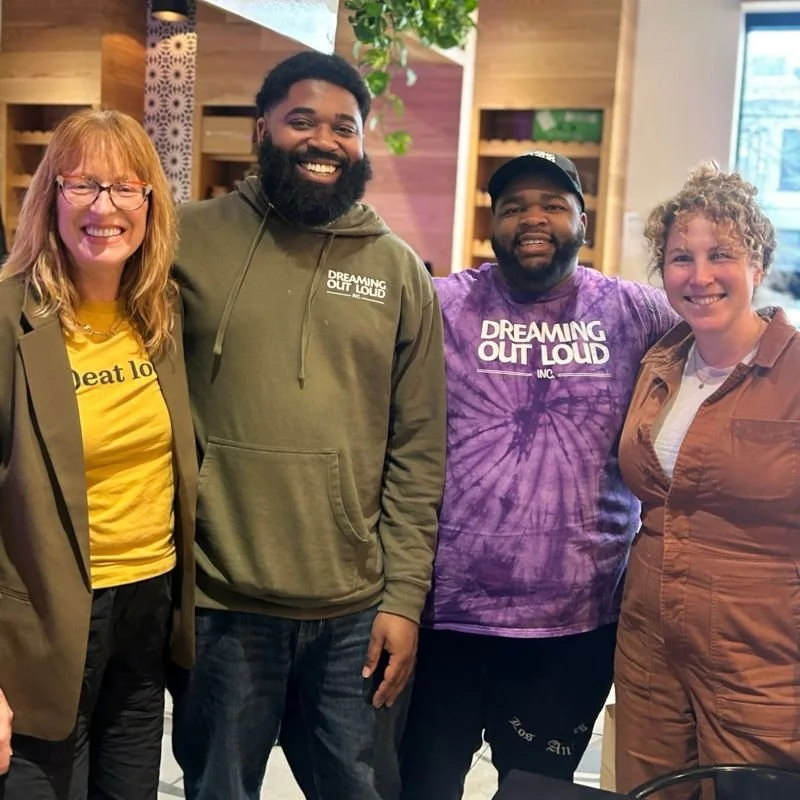
Jennifer (Firsthand Foods), Lester and Devonte (Dreaming Out Loud) and Ellie
Case in point: starting this month, Firsthand Foods is delivering pasture-raised meats from NC farms all the way to Dreaming Out Loud in Washington D.C., through the connective tissue of the Eastern Food Hub Collaborative and with logistics support from fellow member Farmer Foodshare. No single hub could pull that off alone. Together, they just did. And that folks is how the sausage gets made.
With love,
Elizabeth
P.S. - Not yet signed-up for our newsletter? Do so here.
We solemnly swear that we’ll never share your email or spam your inbox.
What We’re Cooking Up
The weather is warming up, the garden is starting to bloom, and the farmers market is getting more exciting each weekend. We’re ready to turn up some tunes, call some friends, and have ourselves a party. What are you bringing? Here’s a few of our dinner party favorites.
Will: My daughter turns three at the end of the month. In our current life chapter, a lot of our “dinner” parties don’t happen at night. Sometimes it’s a pajama party brunch at 9:30am, or a post-nap linner at 4pm. And regardless of the time of day, both me and my kiddo want to eat chicken salad. Brunch? Put it on toast or a bagel with pickled onions. Lunch? Sandwich, duh, with lettuce and extra mayo. Happy hour? Serve with crackers, or as a make-your-own plate with cold blanched asparagus and sliced radishes. I’m planning to try Zaynab Issa’s Afghan murgh kebab-inspired recipe this weekend and use up some frozen boneless, skinless chicken breasts by poaching them with plenty of salt, lemon, and garlic.
Elizabeth: When I’m hosting I want a main that I can pull together while also giving a hug to whoever just arrived, opening a bottle of wine, showing someone where the bathroom is, and turning up the music. Something that doesn’t require a recipe and comes together even when half my brain is focused on other things - think shrimp and grits or risotto. Because I’ve already extolled the virtues of Firsthand Foods spicy fennel sausage let me tell you my foolproof, ready in 10 minutes favorite-recipe-of-this-spring: crispy skillet gnocchi with spicy fennel sausage, cherry tomatoes, asparagus and arugula. It’s so easy: Take a package of aforementioned sausage and remove the casings. Cook until mostly but not entirely browned, over medium high. Toss in a package of shelf-stable potato gnocchi. As the gnocchi cooks and starts to turn a gorgeous golden brown (and your kitchen starts to smell out of this world good) - add in chopped asparagus and cherry tomatoes. Cook until the tomatoes start to blister but the asparagus still has a bite. Top with balsamic vinegar, fresh parmesan, and a few hearty handfuls of fresh arugula. Voila!
And for dessert…
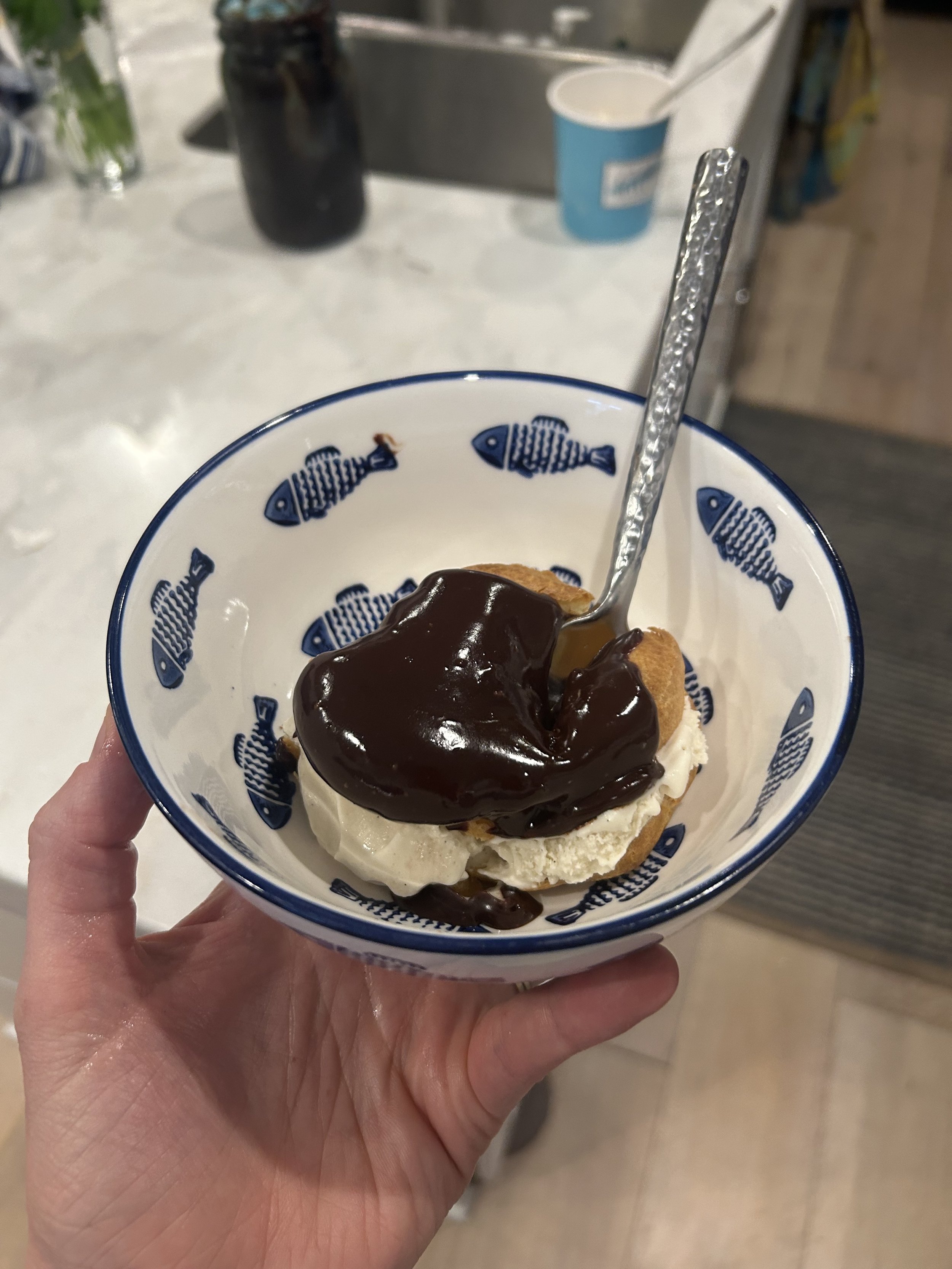
Ellie: A few girlfriends and I spent a rainy weekend at the beach this April. The main focus of the weekend was cooking, followed closely by making silly crafts and watching teen movies from the early 2000s. One of my friends made these lovely profiteroles from Ina Garten. I don’t specifically select my friends based on their pastry skills but…it’s definitely a factor. These profiteroles look great, the texture is super pleasing, and they are SO tasty. Plus, I think they score very well on the minimal effort/maximal payout matrix. And since it’s that time of year - they’d be pretty perfect with some fresh strawberries on top…
Music for your next dinner party
Ellie: In my house, springtime is the best window to have people for dinner on our little back deck. It’s warm and stays light a bit later but the mosquitos haven’t yet made it inhospitable. When friends come over to eat, I’m constantly chasing the high of someone listening to our playlist and saying - “oh hey what’s this song?” I may even like hearing that better than - “wait you guys MADE this?” It’s a close call.
We created this playlist for you to pop on during your next dinner party. It’s chill enough that it won’t distract from chatting but fun enough that you just might get folks dancing after dessert. If it inspires someone to ask you that most flattering of questions, be sure to give us credit. Party on!
New Adventures with Berkshire Agriculture Ventures
Elizabeth: Seed Change Strategies is excited to be a partner on Berkshire Agricultural Ventures' newly awarded USDA Regional Food Systems Partnership Grant — and honestly, it's the kind of project that reminds us why we do this work. BAV has spent years building the relationships and the credibility to make a project like this possible, and we can't wait to dig in alongside them. I sat down with Jake Levin, BAV's local food systems program lead, to talk about the grant, the Berkshires, and his very unconventional path to food systems work.
-
I grew up in a rural farming community. My grandfather was a farmer on the east end of Long Island, and I always felt a deep connection to agriculture — particularly to livestock farming. I grew up with a farm next door where I'd spend summers with the animals and winters eating them. One winter was Sam burgers, the next was Buster burgers.
Food was always the organizing principle of my family. I went to school for fine arts, moved to New York City in the mid-2000s, and when I didn't have a studio, cooking became my main creative outlet. I was living in Williamsburg at an exciting moment for food — the local food movement was just emerging, Omnivore's Dilemma had just come out, Fast Food Nation — and I became particularly captivated by our meat value chain.
I knew I didn't have the constitution to be a chef or a farmer. But a butcher shop had just opened in Williamsburg called Marlowe & Daughters, and I started spending a lot of time there. Around the same time, I got into the MFA program at Bard — which happened to be right across the Hudson River from where the head butcher at Marlowe & Daughters had trained, at a small shop in Kingston called Fleischer's. I did my first summer at Bard and then went to apprentice at Fleischer's for what was supposed to be six weeks. I stayed three or four months and have been working as a butcher ever since — that was around 2010.
From 2010 to 2022, I worked as a butcher in various capacities, always with the goal of being part of a larger food system. I eventually moved back to the Berkshires to run a whole-animal, locally-sourced butcher shop. Even when I had what should have been my dream job — in-house butcher for a Hudson Valley pig farm, making value-added products — I still wasn't feeling satisfied. Then Berkshire Agricultural Ventures posted a position to run their local meat processing support program. The idea of working at a food systems level rather than just as a butcher was really appealing. I applied, and immediately fell in love with the work. That's what I've been doing for the last four and a half years.
-
We're the westernmost county in Massachusetts, spanning north to south with Vermont on our northern border, Connecticut to the south, and New York along our entire western border. It's a very interstate region.
Historically it's been primarily agricultural — livestock and forest products, dairy and wool sheep. A lot of that farming has changed, but it's shaped our landscape: open pasture, rolling hills, mountain ridges on either side with the Hudson River and Connecticut River Valley beyond them. It's genuinely beautiful.
Our proximity to Boston and New York — about two and a half hours — made the Berkshires a summer destination for some of the wealthiest families in American history early on. That created an interesting dynamic for a rural community: strong food systems and food ways, but also, for a rural area, really remarkable cultural infrastructure — Tanglewood, Jacob's Pillow, MASS MoCA, the theater festivals. For someone like me who grew up here, moved to the city, and always yearned for the woods and the swamps and the hills — I felt I could come back and live the life I wanted as an artist while still being connected to culture and making a living in agriculture. We're really lucky that way.
-
We have fantastic livestock producers raising really delicious pork and beef, and I love our maple syrup. But the one thing that's truly particular to the Berkshires — and it's not actually edible — is the Howden pumpkin. The standard carving pumpkin you see throughout America was developed right here in Sheffield by the Howden family. Bruce Howden is someone I've had the pleasure of knowing; it was his father and grandfather who developed it. I'm an obsessive about gourds and pumpkins — my wife has had to set a budget for how many I can buy each October.
I'd also mention Lila Berle’s Mountain Farm in Great Barrington, right where BAV is based. They have one of the largest wool flocks in the state, now run by Mary Berle. I have a sweater from her that I love, and it's one of the most beautiful farms in our region.
-
BAV was founded in 2017 with the mission of providing technical assistance and financial support to farmers and agricultural businesses — and that's still at the core of what we do. We provide a lot of direct business technical assistance to farmers, including grant writing support. We also offer low-interest, flexible loans, which is critical because many farmers in our region would otherwise have trouble accessing capital. We have a revolving loan fund dedicated specifically to meat processors that I work closely on.
On the food systems side, my role focuses on building capacity and resilience for meat processing to create more viability for our livestock farmers, and on unlocking new market channels — which is what we're trying to do with the RFSP grant and farm-to-institution. I also manage our market match program, which provides grants to Berkshire farmers markets so they can double SNAP benefits.
It's systems change work plus wraparound support for farmers and agricultural businesses — which is also why it's hard to answer "so what do you do?" in a sentence.
-
The Regional Food Systems Partnership Grant is a two-year planning grant. The goal is to develop, with strategic support, an action-oriented blueprint for BAV to build a wraparound support program for expanding the farm-to-institution value chain in our region. This project is really about pinpointing where the opportunities are and identifying the key partners to make it happen.
I keep saying this a little cheekily, but I sort of mean it: what I'm most excited about is the possibility of my daughter — who goes to the same public school I went to — having spaghetti and meatballs, which is her favorite school lunch, made with locally sourced tomato sauce and meatballs. That's really my goal. You can extend that vision throughout the whole system, but at the end of the day, I just want to see that happen for our kids and everyone else in the community.
-
The strength of our proposal came down to the partners we were able to pull together — and that's the result of years of relationship-building that everyone at BAV has done. It can seem like, why are we taking time to meet with this person, or just get to know someone without a specific goal in mind? But in the long run, it really pays off. When an opportunity develops, you can pull people together somewhat effortlessly.
I also think having a previous successful RFSP helped — being able to reference that track record and talk about how we were using it as a model. Funders want to award people who are actually going to get things done, not just put reports on a shelf. We've worked hard to build a reputation as people who follow through, and I think that matters.
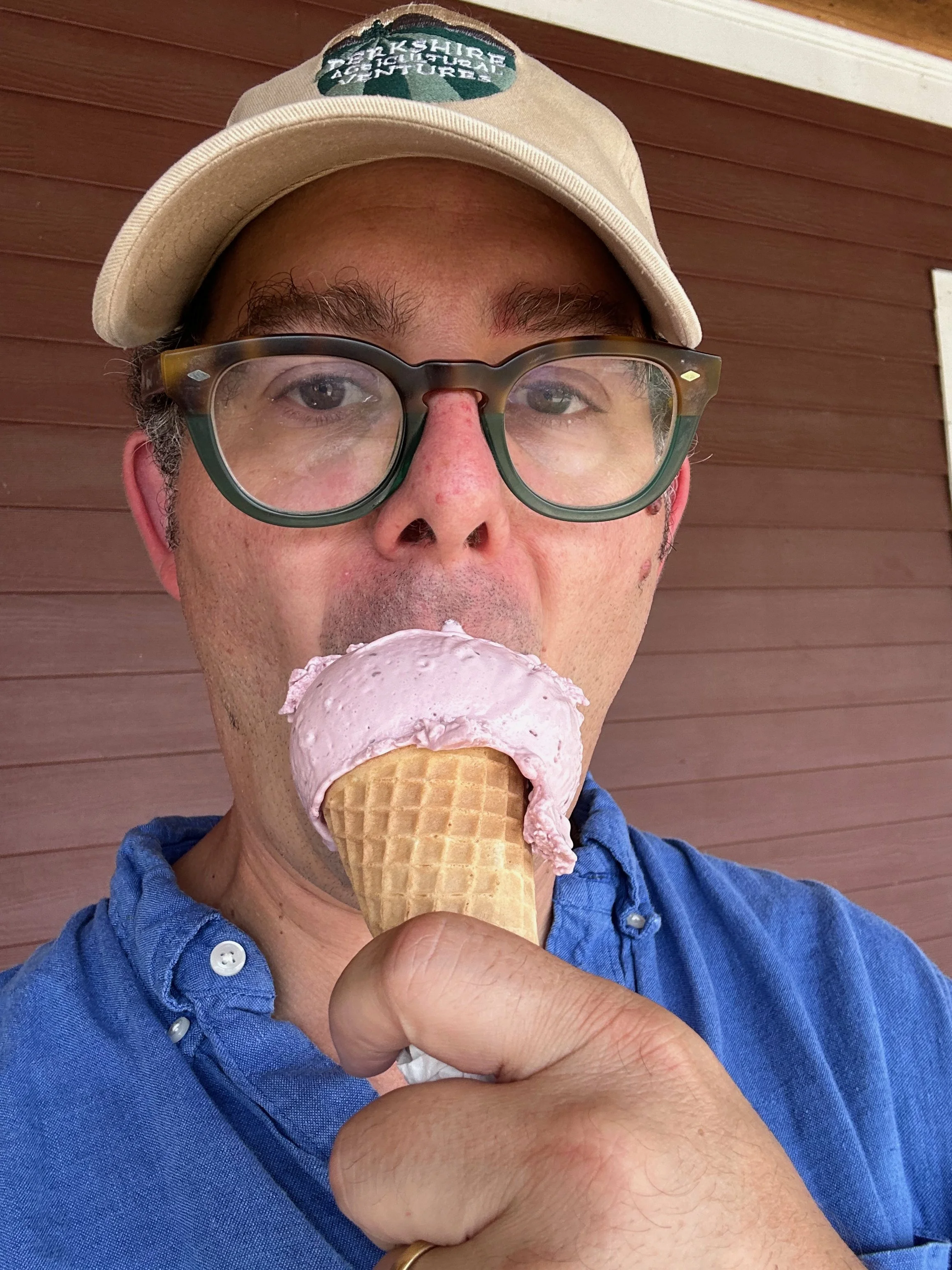
Jake Levin supporting the Berkshire food system with some local ice cream
“What I’m most excited about is the possibility of my daughter — who goes to the same public school I went to — having spaghetti and meatballs, which is her favorite meal, made with locally sourced tomato sauce and meatballs at lunch. That’s really my goal. You can extend that vision throughout the whole system, but at the end of the day, I just want to see that happen for our kids and everyone else in the community.”
What’s On The Horizon
Ellie: Huge news - in March, Seed Change was awarded a USDA Local Food Promotion Program grant to support the Eastern Food Hub Collaborative (EFC)! The EFC is a network of 16 food hubs spanning from Maine to South Carolina. Seed Change serves as the backbone organization for the EFC, providing facilitation, project management, and strategic support.
The EFC has pretty big dreams. The long game is to compete with the dominant consolidated, extractive food system with a decentralized system based on trust, transparency, and shared strategy. Instead of a few companies owning all of the food distribution for the entire eastern US, what if 16 (or 18, or 40…) place-based, values-driven, community-minded food hubs worked together to feed our broader region? What if we could scale out and stick to our values instead of scaling up and having to cut corners?
Through this grant, we're taking big steps towards that vision. In addition to supporting lots of nerdy network governance and peer learning stuff, this grant will ramp up the infrastructure for hubs to trade with each other. The plan is that a small farm in North Carolina will be able get its sweet potatoes to a Food is Medicine program in New York, or a student in a cafeteria in Maryland will be able to eat cheddar from an independent dairy in Vermont. A lot of these systems have been bubbling up in the EFC since its inception in 2020, and we’re ready to take them to the next level. We’re eager to see how new market channels, like Food is Medicine, can develop stable, scalable demand for this kind of regional sourcing, and what systems, processes, and support is needed to meet it. It could be a crazy idea, but it’s pretty bad out there, so we might as well swing for the fences.
We’re wary of implementing a grant from the current federal government. We’ve had several tough conversations with each other, members, and other partners and friends in the sector about the risks and rewards of that relationship right now. We’re staying optimistic, and also highly pragmatic about what this funding can and can’t do. And we’ll keep leaning on allies and experts as we navigate.
At a moment when so many are forced to play defense against threats, cuts, and uncertainty, we feel so energized to be playing offense. Addressing the challenges that make our food system unfair and harmful requires new, bold strategies and we’re hoping that we can use this time to create something lasting and powerful in the midst of so much fear and stress. Keep an eye out for more information as this project develops, and if you see some small batch honey from a couple states over in your local market, you may have the EFC to thank.
Learning Corner: Finding Flow
Will here, ready to nerd out about one of my favorite mental phenomena: flow states. We just wrapped up leading a four-part learning series about addressing burnout at work with a bunch of lovely folks in the New Entry National FIELD Network. One of our sessions was focused on finding ease in the difficult work of systems change, and I got to take us on a side-quest to explore flow states and how we experience them.
(Disclaimer: I’m not a psychologist; I’m not an expert on neuroplasticity or the active mind or any of this. I just like thinking that we can listen to our bodies and learn something about what we need to be happy and fulfilled and successful.)
Flow is the feeling of being “in the zone;” when you’re doing something difficult, and you’re kicking its butt anyways, and it starts to feel, somehow, easy. Your conscious mind quiets down, time speeds up, and you just flow – all while doing something that any onlooker would correctly describe as being objectively difficult. It’s both personal (what gets you into a flow state is very different from what gets me flowing) and at the same time, it’s a universal human experience, spanning global cultures and generations.
The Hungarian-American psychologist Mihály Csíkszentmihályi coined the term “flow” and brought it into the public eye in 1990. He defined flow as being an intrinsically-motivated state in which the person demonstrates “complete absorption in an activity, where the challenges of the task match the individual's skills and abilities.” For more in Mihály’s own words, check out his TED Talk.
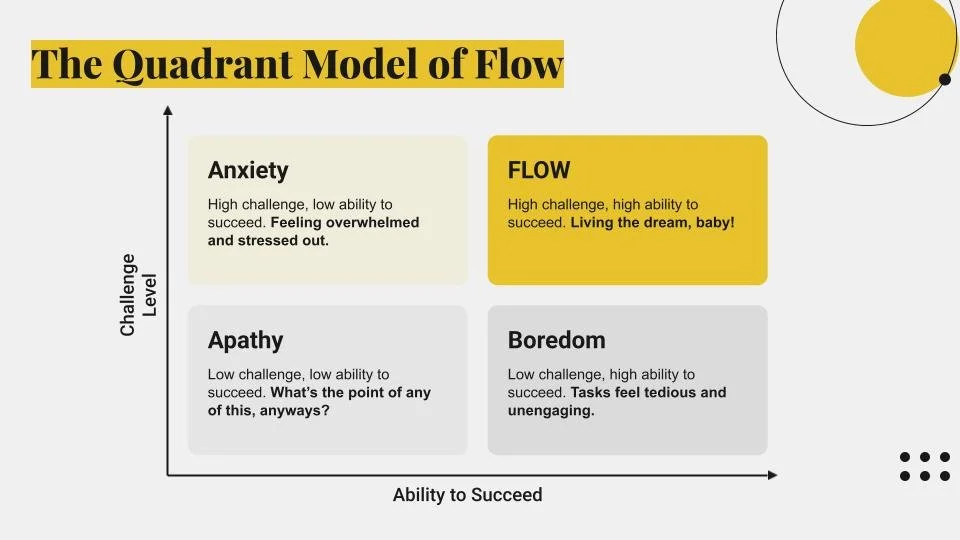
Where do you find the sweet spot of flow?
You most often find it when a few conditions are met: 1) you’re facing a challenge that pushes your limits; 2) you possess the expertise, skill, and ability to succeed despite that challenge; 3) you’re intrinsically self-motivated to complete the challenge; and 4) you’ve made an active, purposeful decision to do so.
I tend to find flow when I’m hot, sweaty, and outside. For the last few years, I’ve been digging all the grass out of our yard in Richmond, VA and converting it into gardens - that gets me in a great flow state (with the sunburns to prove it). Walking, hiking, running, backpacking - all things that get me in the zone and make my brain and body feel good.
But I’m trying to find it at work, too. Or, more precisely: I’m trying to pay more attention to what makes hard things feel easy at work, and what makes simple tasks seem impossible. I’m drawn to Csíkszentmihályi's premise of intrinsic value, and asking: why is what I’m doing important to me? How is this (often frustrating and tedious) work part of a larger challenge that I’m going to overcome?
I’m not suggesting you can hack your brain so you work effectively all the time, or that you should. But I’m interested in the idea that by observing what gets me into a flow state, I might also learn way to find ease in the challenges of my work life.
What’s flowing for you right now? Where are you stuck? I don’t know if I can help, but I’d love to go for a walk and talk it through.
Thank You For Being A Friend
Because if you’ve made it this far, you really are a friend. If we haven’t caught up in a while then let’s find a time to chat.
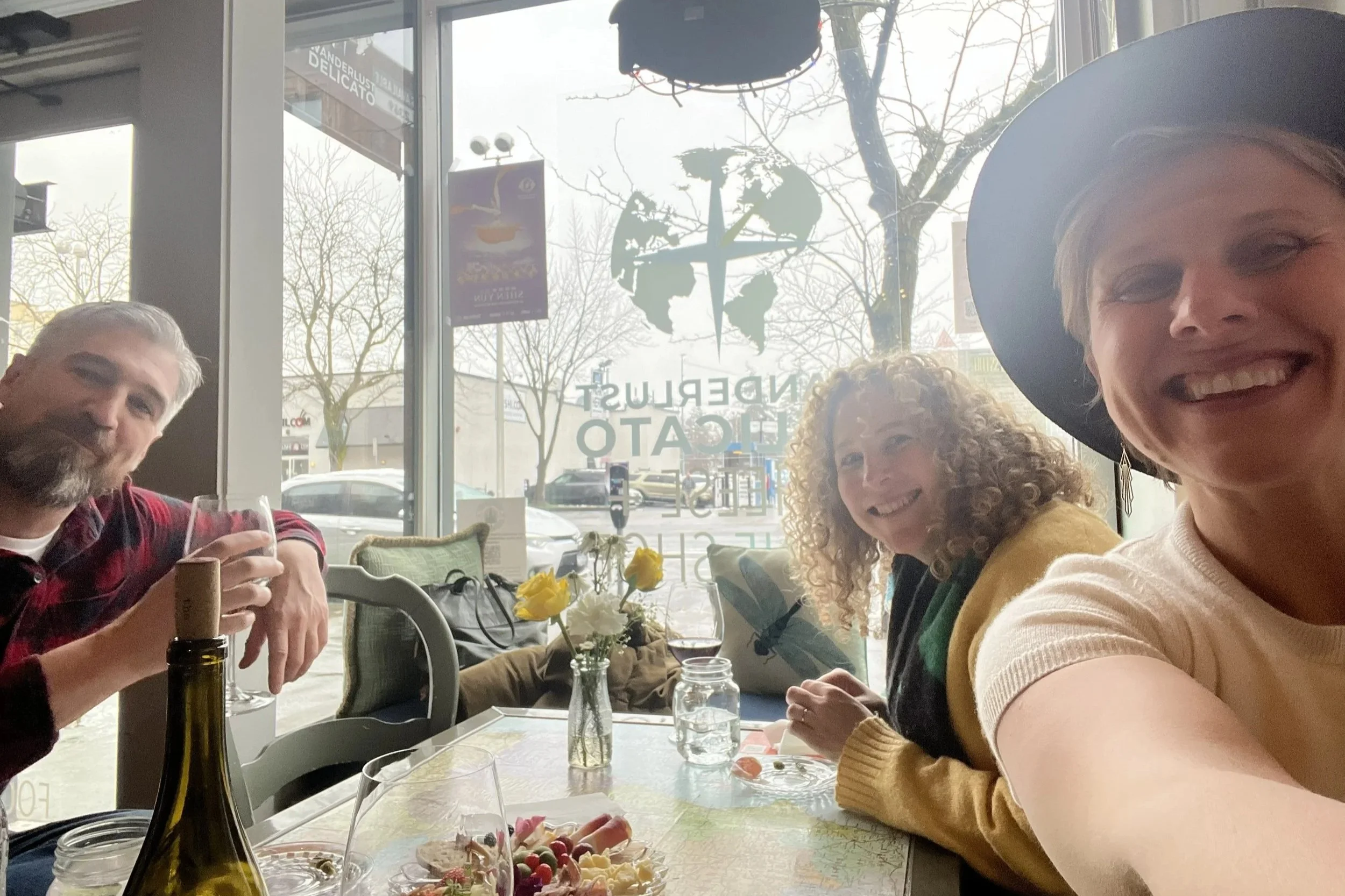
Will, Ellie, & Elizabeth taking a break after the Food Hub Network Mangers Community of Practice convening in Spokane, Washington.